
In recent years, VR has become a widely adopted standard in professional training—especially in industries where risk is high and mistakes are costly. From offshore platforms to mining operations and diving, organizations are increasingly turning to immersive training environments to prepare their teams for complex, real-world scenarios.
The promise of XR technologies was clear: create realistic simulations, reduce risk, and allow people to learn by doing. And in many ways, this promise has been fulfilled.
But something is still missing.
Most VR-based training experiences are designed for individuals. A single user, wearing a headset, enters a simulated environment alone. While this enables deep focus and personal immersion, it also introduces a critical limitation: isolation.
In real-world operations, especially in high-risk environments, people rarely act alone. Decisions are made in teams. Observations are shared. Situational awareness is collective.
This is where a new approach to innovative training begins to emerge.
Beyond Isolation: Towards Shared Immersion
Imagine stepping into a training environment where you are not cut off from others—but fully present with them.
A space where simulation is not confined to a headset, but surrounds you physically. Where image and sound wrap around your field of perception, creating a seamless and natural sense of presence.
This is the idea behind sharedVR—or more precisely, shared immersive environments.
Instead of isolating individuals, this approach places entire teams inside a common simulation space. Participants can see each other, communicate freely, and experience the same scenario at the same time.
It transforms training from a solitary exercise into a collective process.
A New Training Paradigm: Learning Together
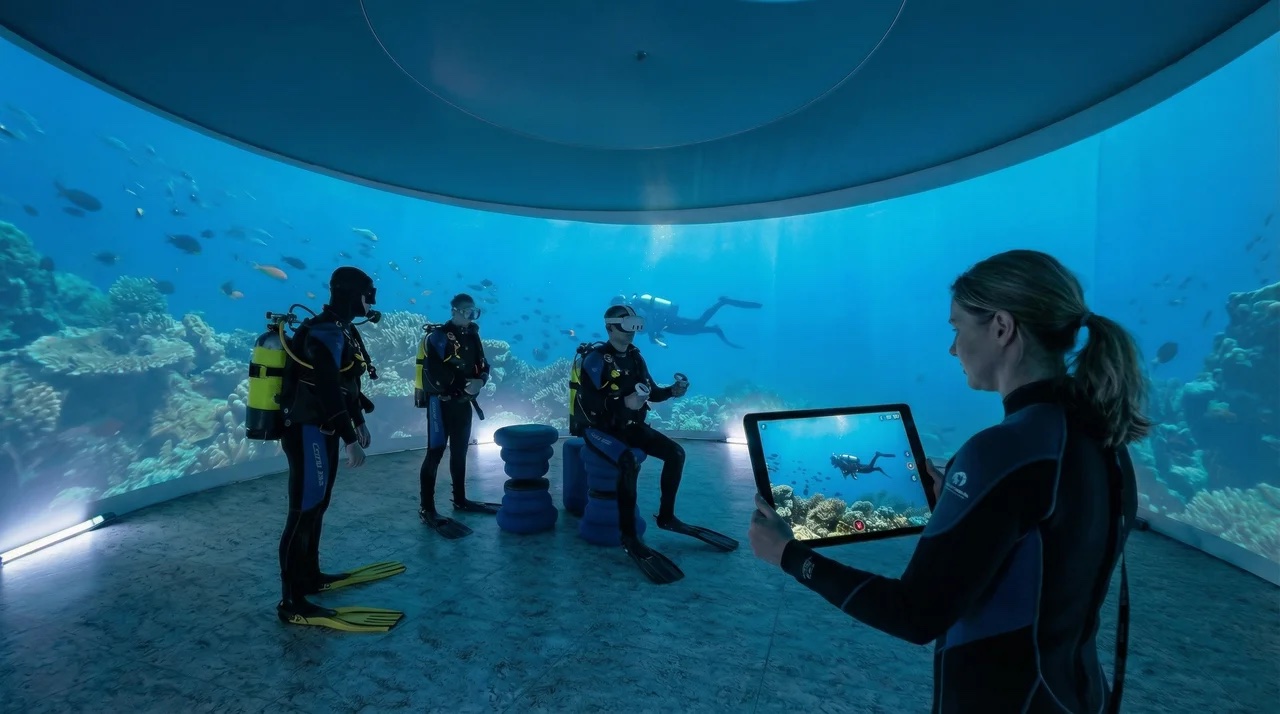
Consider a group of diving trainees preparing for their first real descent.
They stand inside a cylindrical immersive environment. Around them, a 360-degree projection displays a detailed underwater scene. The screen, scaled to human proportions, allows them to perceive depth, distance, and movement naturally.
A single diver appears in the simulation—navigating a coral reef or approaching a submerged wreck.
The trainees are not passive observers.
They watch closely, noticing body position, buoyancy, and environmental cues. They anticipate potential risks. They exchange glances, comments, and questions.
Next to them, an instructor guides the experience in real time—pointing out critical details, explaining decisions, and encouraging reflection.
This is not just visual exposure. It is immersive training that engages perception, cognition, and collaboration simultaneously.
And importantly—it happens in a safe training environment, where mistakes carry no real-world consequences, but still generate meaningful learning.
Why This Shift Matters
High-risk professions demand more than procedural knowledge. They require awareness, coordination, and the ability to make decisions under pressure.
Traditional VR solutions address part of this challenge by enabling individuals to practice specific tasks. However, they often fall short when it comes to team dynamics and shared situational understanding.
By contrast, shared immersive environments allow participants to:
- experience the same situation from a common perspective
- build collective awareness
- discuss and interpret events in real time
- learn not only from the simulation, but from each other
This makes training more aligned with how real operations actually unfold.
Removing Barriers, Increasing Engagement
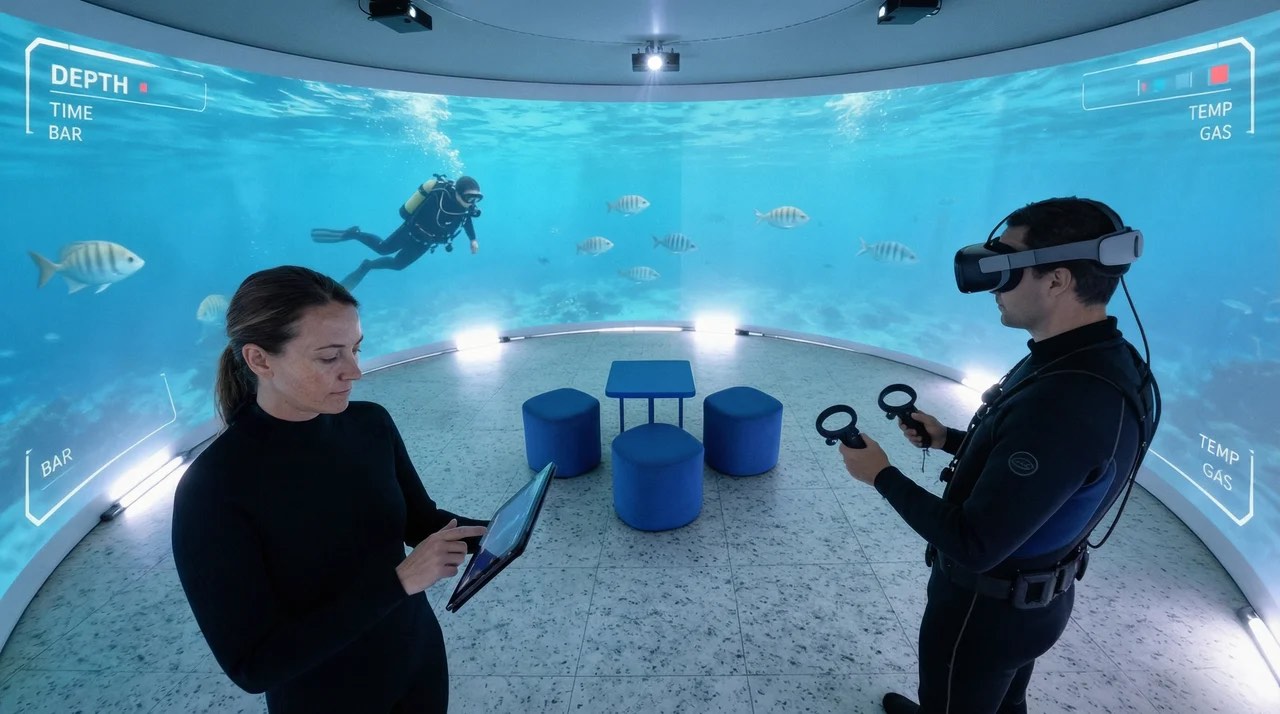
Another important aspect of this approach is the absence of head-mounted displays.
While VR headsets can be powerful, they also introduce practical challenges—discomfort, motion sickness, hygiene concerns, and limited accessibility.
By removing these barriers, shared immersive systems make innovative training more inclusive and scalable.
Participants remain physically present, aware of their surroundings, and connected to others. At the same time, they are fully engaged in a rich, sensory environment that enhances focus and retention.
From Simulation to Decision-Making
The implications of this model go beyond training.
Shared immersive environments can also serve as platforms for analysis, scenario planning, and decision-making. Teams can explore possible situations, test responses, and evaluate outcomes together.
This opens new possibilities across domains such as crisis management, infrastructure operations, and urban systems.
In this context, XR is no longer just a visualization tool—it becomes a medium for collective thinking.
Conclusion
The evolution of VR has brought us closer to realistic, experience-based learning. But the next step is not deeper immersion in isolation.
It is immersion shared with others.
By combining the strengths of XR, the realism of immersive training, and the dynamics of group interaction, this new approach redefines what effective training can look like.
Because in high-risk environments, the most important skill is not just knowing what to do.
It is knowing how to act—together.