
In recent years, there has been growing discussion about the use of immersive technologies in spatial planning, public consultations, and design processes. Most often, this conversation focuses on virtual reality based on VR headsets, which allows users to enter digitally created environments and experience them from an individual perspective. This solution has opened entirely new possibilities for visualization and project analysis.
However, in the context of social participation, an important question arises: is an individual experience always the best answer where shared understanding, dialogue, and collective decision-making are essential?
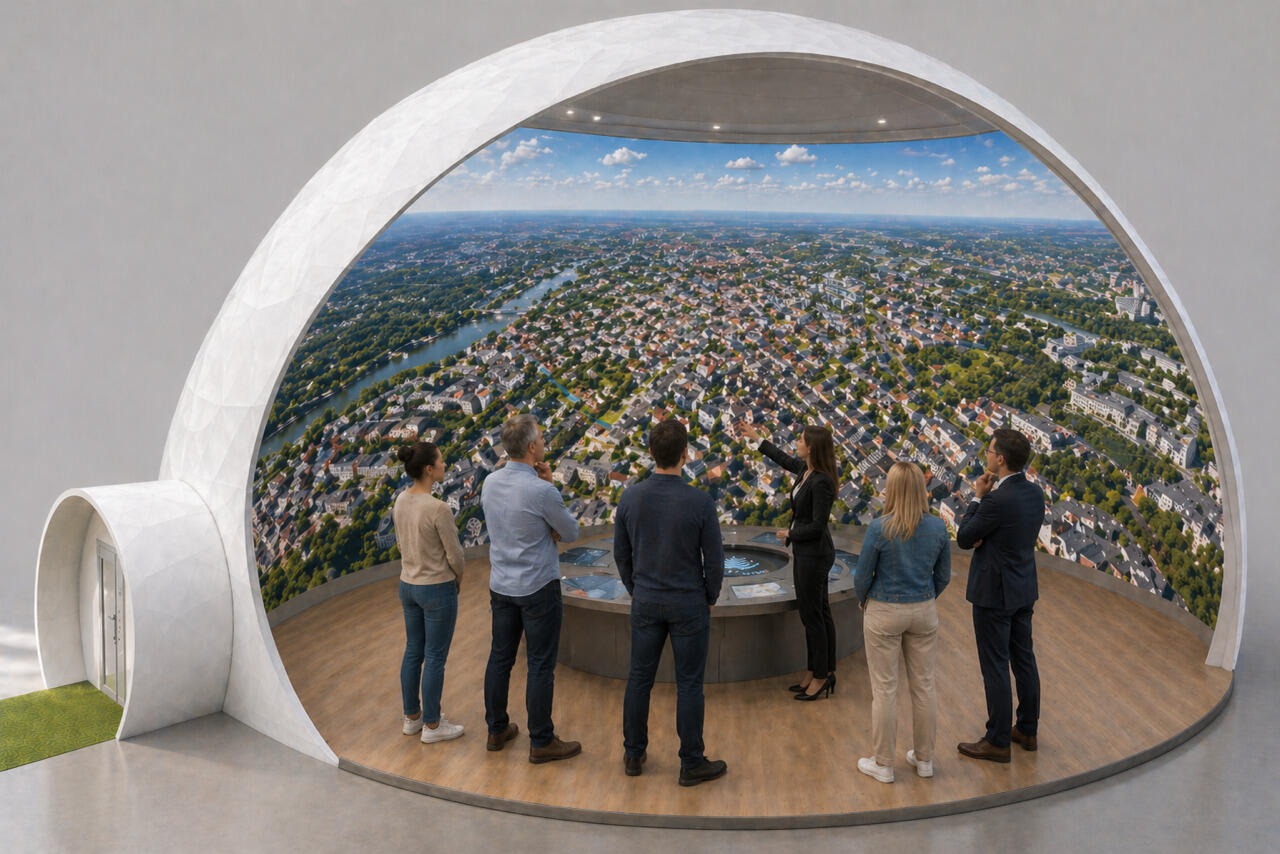
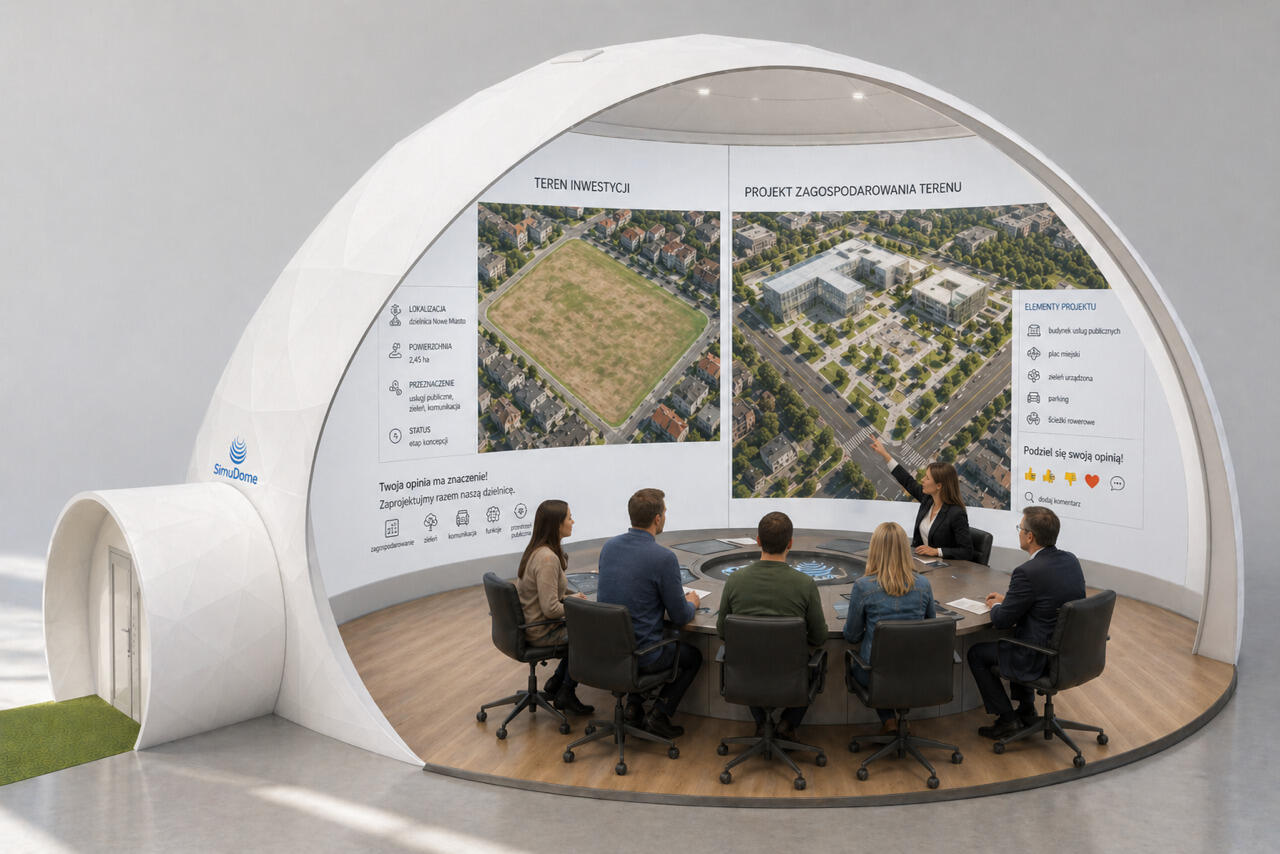
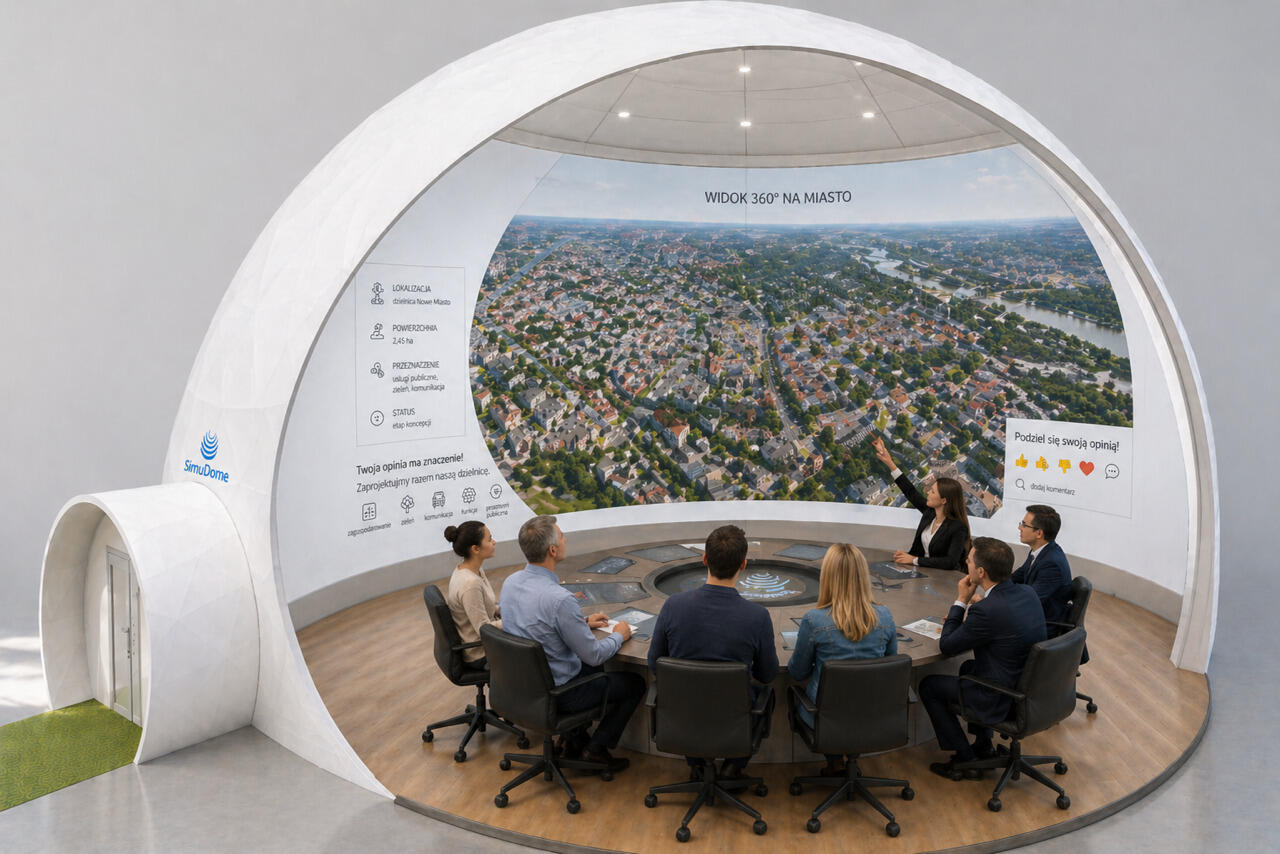
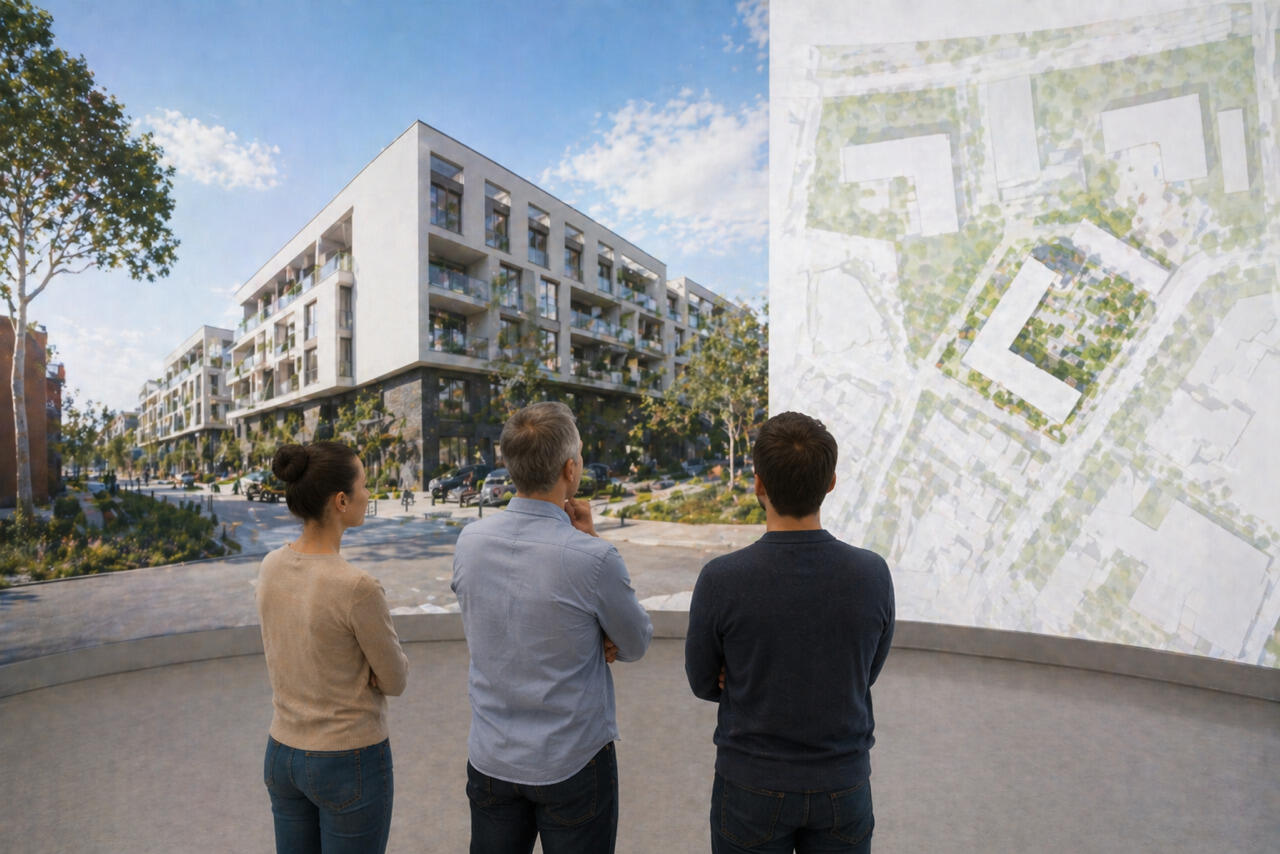
This is where SimuDome comes in – a solution that does not compete with traditional VR, but rather serves as its meaningful complement. It is an immersive dome environment in which multiple people can simultaneously experience the same model, scenario, or visualization. Instead of isolating participants in separate headsets, SimuDome creates a shared immersive space where analysis, discussion, and reactions happen together, in real time.
What is SimuDome?
SimuDome is a spherical immersive projection environment that enables the display of 3D content, spatial models, simulations, and scenarios at a group scale. It can function as a tool for collective viewing, analysis, and decision-making in situations where space, change, and social impact are key.
Its advantage does not lie in replacing VR headsets, but in introducing a new quality: shared immersion.
In practice, this means that residents, urban planners, investors, public officials, experts, designers, and decision-makers can gather in one space to simultaneously see the same proposal, compare alternatives, analyze the impact of changes, and discuss them directly.
VR and SimuDome – a difference not in technology, but in participation logic
Traditional VR is highly effective where individual immersion is needed – personal training, first-person experiences, or testing the reactions of a single user. Headsets work best when a specific person needs to follow a defined path, complete a task, or see the world from a particular point of view.
But social participation follows a slightly different logic.
In consultation processes, it is not only about seeing something. It is also about:
- seeing it together,
- comparing different perspectives,
- reacting immediately to others’ comments,
- building a shared understanding of the situation,
- and making decisions in an environment that fosters dialogue rather than isolation.
In VR headsets, each participant is separate. Even if they are looking at the same model, they experience it individually. This makes natural conversation, spontaneous exchange of opinions, and joint analysis more difficult.
SimuDome works differently. Participants are in the same physical space, see the same image, and can discuss, point, compare options, and immediately respond to each other’s reactions. This is especially important wherever decisions concern shared space and a shared future.
Why SimuDome can enhance the quality of social participation
Social participation is often reduced to communication: presenting plans, publishing documents, holding consultation meetings, or collecting feedback. The problem is that such a model usually offers a limited level of real influence.
If residents are to truly participate in the process, they need not only information, but also an understanding of space, possible scenarios, and the consequences of decisions. This is often difficult when based on plans, maps, boards, or even standard visualizations.
SimuDome can significantly lower this barrier because it:
- presents projects in a more intuitive spatial scale,
- enables comparison between current and future states,
- supports work with 3D models, spatial data, and change scenarios,
- creates a shared experience that strengthens discussion,
- increases the sense of presence in the analyzed environment.
It is not just a presentation tool. It can become an environment for collective thinking about space.
A key advantage: the same content can work in VR and in the dome
One of the most interesting aspects of SimuDome is that, at the current stage, the same content can be displayed both in VR headsets and in the dome environment. This creates a bridge between individual and collective experience.
As a result, the process can be multi-stage:
first, experts or designers work in VR, and then the same material is transferred to the dome, where it becomes a tool for collective consultation, presentation, and analysis involving a larger group.
This means that SimuDome does not exclude VR. On the contrary – it extends it toward co-decision-making and broader social impact.
Where can SimuDome be an ideal solution?
1. Urban design and city transformations
This is one of the most natural application areas.
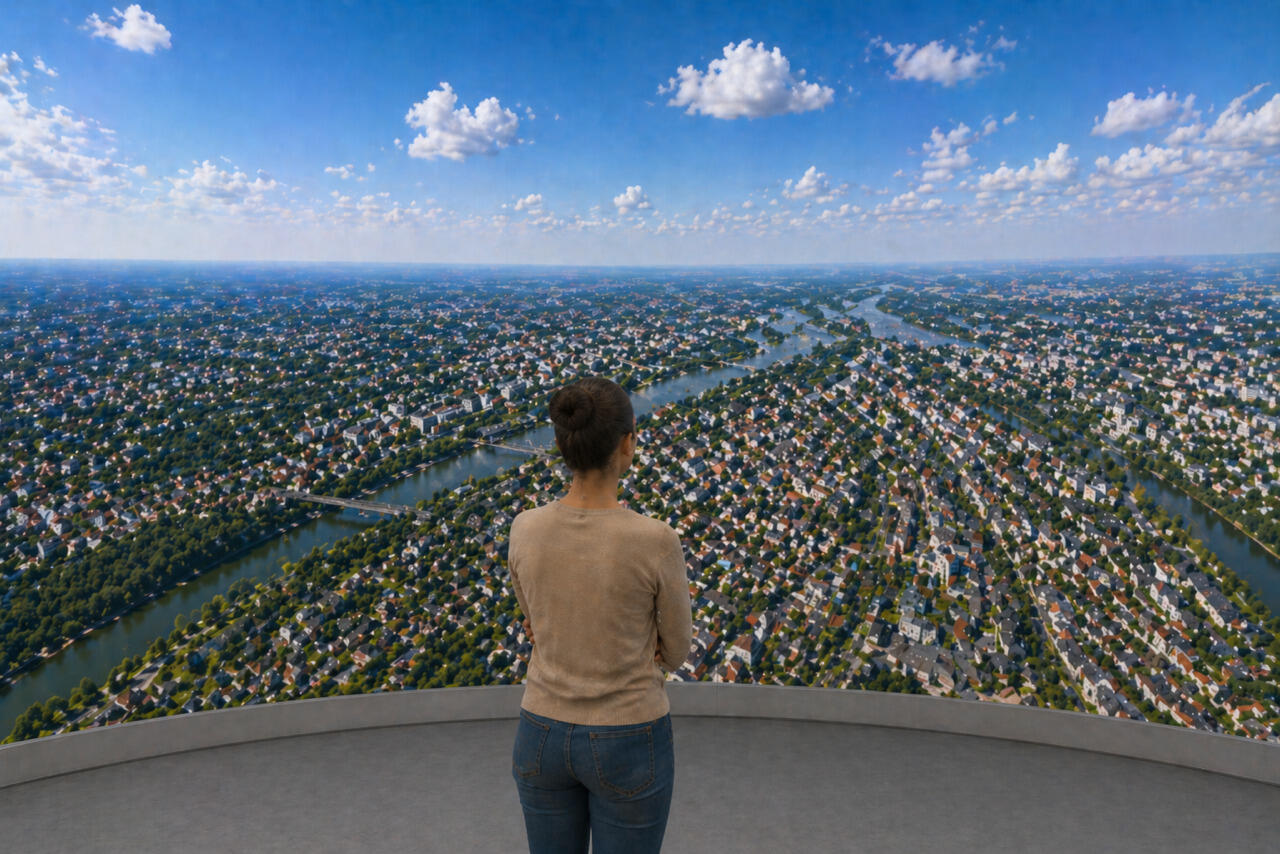
Imagine a consultation process regarding the redevelopment of a city square, new housing developments, traffic reorganization, urban greenery, or public infrastructure placement. Typically, residents see boards, maps, and individual visualizations that do not always convey scale or impact.
In SimuDome, it is possible to present:
- the current state of a place,
- multiple development scenarios,
- pedestrian and vehicle flows,
- shading,
- relationships between buildings,
- the impact of investments on views, accessibility, and spatial function.
Residents and decision-makers can jointly see what a change will look like and what consequences it may bring. This increases transparency and reduces conflict resulting from misunderstanding.
2. Revitalization and modernization of existing areas
In renovation and revitalization projects, balancing different interests is crucial – residents, conservation authorities, investors, architects, local governments, and users of the space.
SimuDome can be used to show:
- what is preserved,
- what changes,
- how new elements fit into the existing environment,
- how the project affects everyday experience.
This is particularly important in places with strong emotional and social significance, such as historic districts or public spaces.
3. Climate adaptation
This is an area where visualization and shared analysis will only become more important.
Climate change is difficult to communicate because it is often abstract, long-term, or data-driven. SimuDome can make these processes more understandable.
Examples include:
- flood simulations in specific urban areas,
- analysis of urban heat islands,
- the impact of land use changes on water retention,
- consequences of lack of greenery and over-sealing,
- adaptive scenarios for districts and neighborhoods.
Instead of talking about risks, people can see them together, compare scenarios, and discuss concrete adaptation actions.
4. Infrastructure and public investment planning
Large investments often face resistance not because they are flawed, but because they are poorly communicated. People do not understand their scale, impact, or rationale.
SimuDome can support consultations around:
- new transport lines,
- redevelopment of transport hubs,
- energy investments,
- water infrastructure,
- new public facilities.
In the dome, technical data can be combined with spatial visualization, moving from the language of documentation to the language of experience.
5. Civic education and strategic processes
Participation does not have to concern a single project. It can also support understanding of broader processes such as urban development, spatial policy, environmental protection, safety, or resilience.
SimuDome can be used as a space for:
- strategic workshops,
- public meetings,
- spatial education,
- cross-sector collaboration,
- building shared awareness of challenges.
This is especially valuable when expert knowledge needs to connect with lived experience.
The greatest value: shared presence
The most important distinguishing feature of SimuDome is not just the image. It is the fact that the image becomes a shared space for conversation.
In many social processes, the main challenge is not a lack of data, but a lack of shared understanding. Some rely on technical documentation, others on emotion, and others on everyday experience. SimuDome can become a space where these perspectives meet in a more tangible way.
This is why the dome can be such a powerful complement to VR. It does not diminish its value. It shifts the experience from “I see” to “we see together.”
The future of participation may be shared
If social participation is to be more than a formality, we need tools that genuinely increase understanding, dialogue, and the ability to anticipate the consequences of change together.
SimuDome fits precisely into this direction. As a shared immersive environment, it can fill the gap between individual VR experience and the social need for collective viewing, discussion, and co-decision-making.
In a world of increasingly complex urban, climate, infrastructure, and social challenges, it may no longer be enough to immerse individuals in virtual reality. It may be necessary to immerse entire groups together – to better understand the reality we are shaping collectively.