
Why Does Immersive Training Help People Remember Better? What Research Says
Is training more effective when participants do more than listen to an instructor and watch slides – when they actively take part in a simulated situation?
Research on VR, fulldome, CAVE and simulation-based training shows that well-designed immersive training can support knowledge retention, attention and the learning of practical procedures.
This is particularly relevant in areas such as:
- safety training,
- crisis management,
- civil protection,
- industrial training,
- evacuation,
- healthcare,
- emergency procedures,
- decision-making training.
Unlike traditional presentation-based training, interactive immersive training allows participants to enter a scenario, observe their surroundings, make decisions and experience the consequences of their actions.
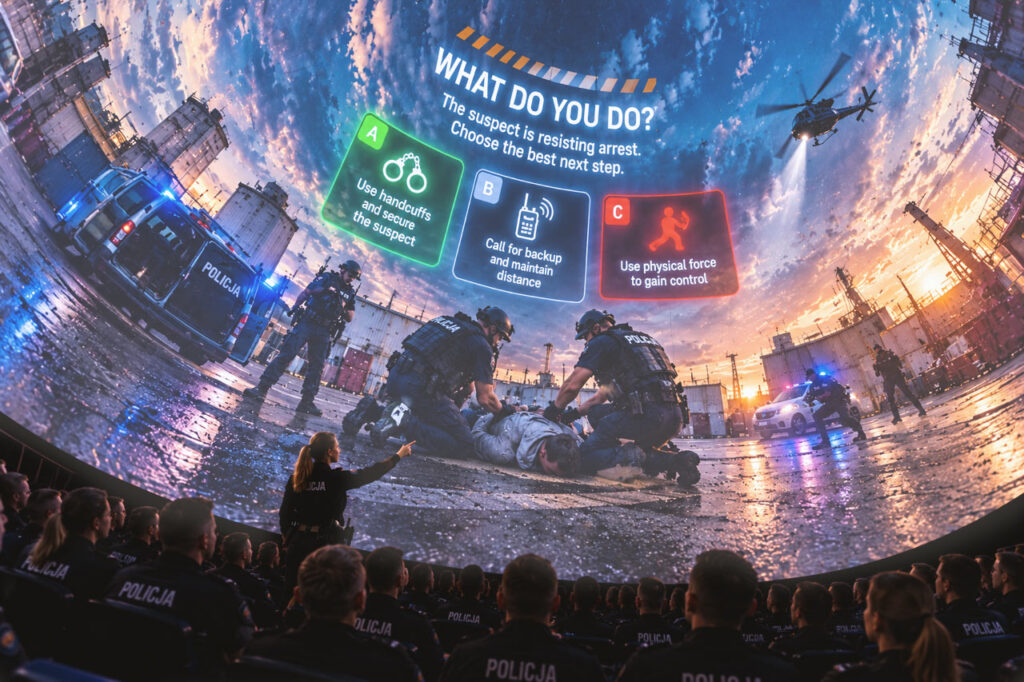
Fulldome environments can support knowledge retention
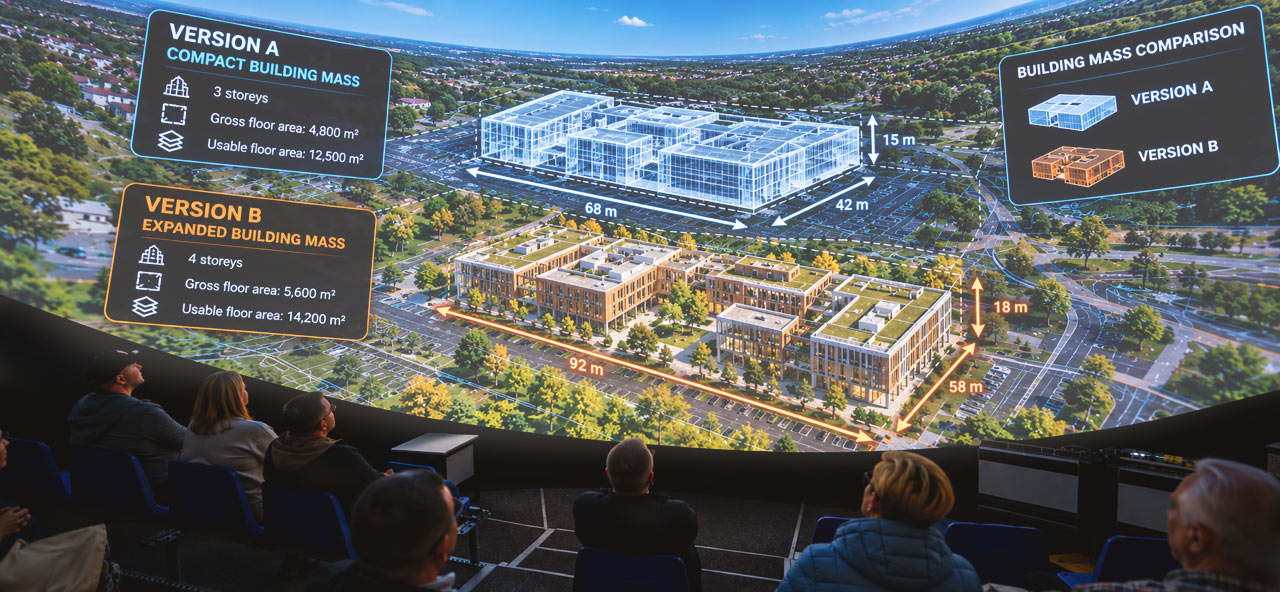
One study particularly relevant to SimuDome involved 781 university students.
Researchers compared learning the same content in:
- an immersive fulldome planetarium,
- a traditional classroom with a flat screen.
The instructors, visual materials and educational content were kept consistent.
The highest knowledge retention was observed among students learning in the fulldome environment.
The researchers suggested that the wide field of view and large surrounding imagery characteristic of dome projection may increase attention and contribute to learning outcomes. (journals.modernsciences.org)
This is particularly relevant to SimuDome because the study did not involve individual VR headsets, but an immersive dome projection environment.
Meta-analyses show a positive impact of immersive VR on learning
A meta-analysis covering 48 studies and 3,179 participants found a positive effect of immersive VR on learning outcomes.
The average effect was Hedges’ g = 0.38, representing a small but measurable educational advantage for immersive environments. (sciencedirect.com)
This does not mean that every VR training session will automatically produce better results.
It does, however, provide evidence that appropriately designed innovative immersive training can support the learning process.
The same content – better recall in an immersive environment
In another experiment, participants watched the same 360° video:
- in an immersive environment,
- or on a conventional flat-screen monitor.
Researchers then tested how much information participants remembered.
The immersive group achieved significantly better results in the memory test. The researchers concluded that increased immersion can support attention and subsequent recall of information. (link.springer.com)
This is particularly important in training where participants need not only to understand information during the session, but also remember it later when faced with a real situation.
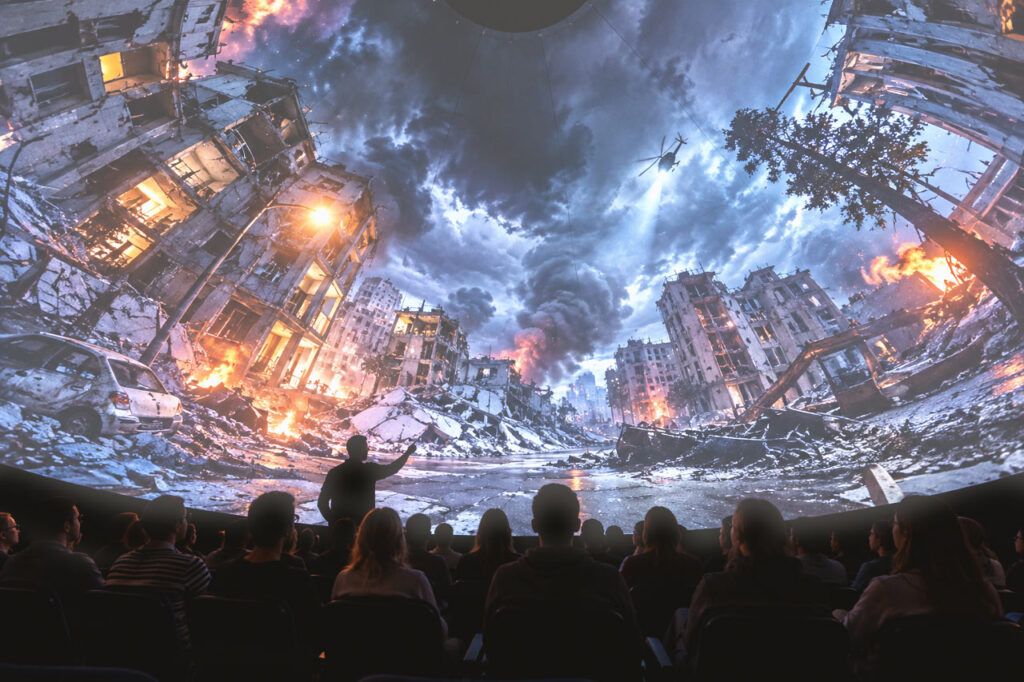
Shared VR and CAVE – immersive group training
CAVE technology is particularly relevant to the concept of shared VR.
Instead of using individual headsets, participants enter an immersive projection environment together.
In a study involving neuroanatomy education, participants using a CAVE environment achieved greater learning gains than those using traditional learning materials.
The benefits were particularly significant for participants who initially had lower spatial ability. (link.springer.com)
This demonstrates the potential of immersive group training, where participants can observe a scenario together, discuss what is happening, cooperate and make decisions.
This is also the principle behind SimuDome – creating shared immersive experiences without requiring every participant to wear a VR headset.
The greatest potential: procedural and practical training
In safety training, the ultimate goal is not simply whether someone can repeat information from a slide.
The more important question is:
Will they know what to do when the situation actually happens?
This is why research into immersive procedural training is particularly relevant.
Scientific reviews indicate that VR can support both procedural learning and the transfer of acquired skills into practical tasks. (sciencedirect.com)
Instead of simply telling participants:
“During a blackout, you should secure an adequate supply of water,”
we can place them inside a simulated home without electricity, internet access or basic services and ask:
What do you do?
Participants must assess the situation, make a decision and experience its consequences.
This is the difference between passive instruction and practical immersive training.
VR in safety training
A systematic review and meta-analysis published in Safety Science analysed 52 publications on VR-based safety training.
The analysis found that VR training performed better than traditional approaches in both knowledge acquisition and knowledge retention. (sciencedirect.com)
The reviewed research covered areas including:
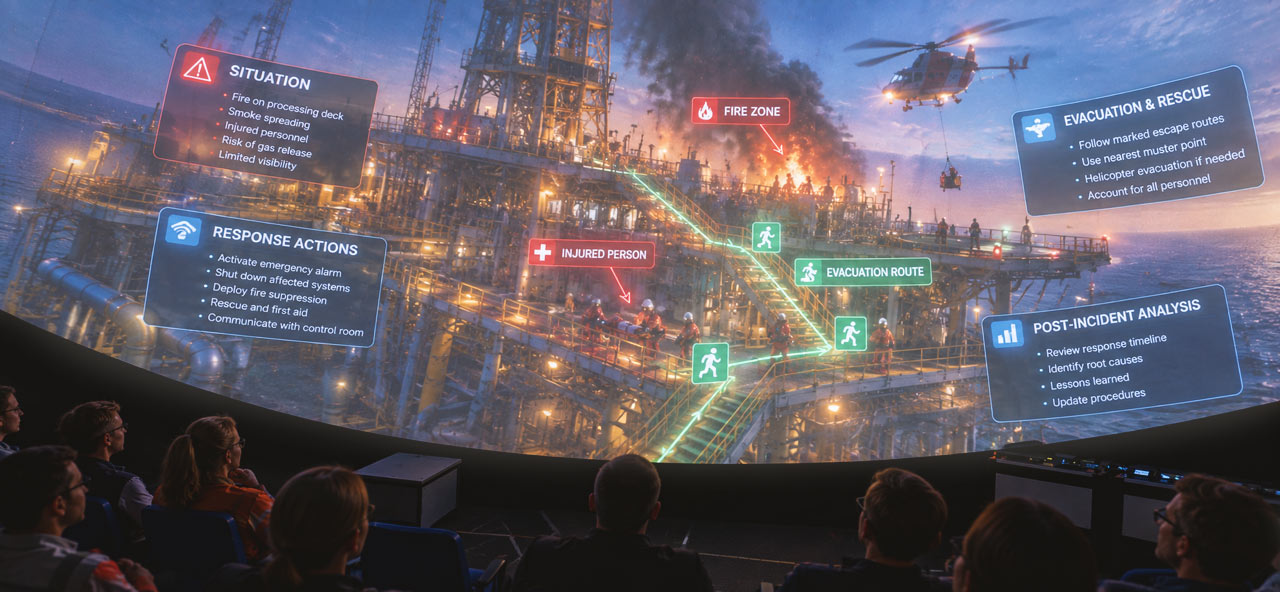
- fire safety,
- construction,
- industrial safety,
- aviation,
- hazard training.
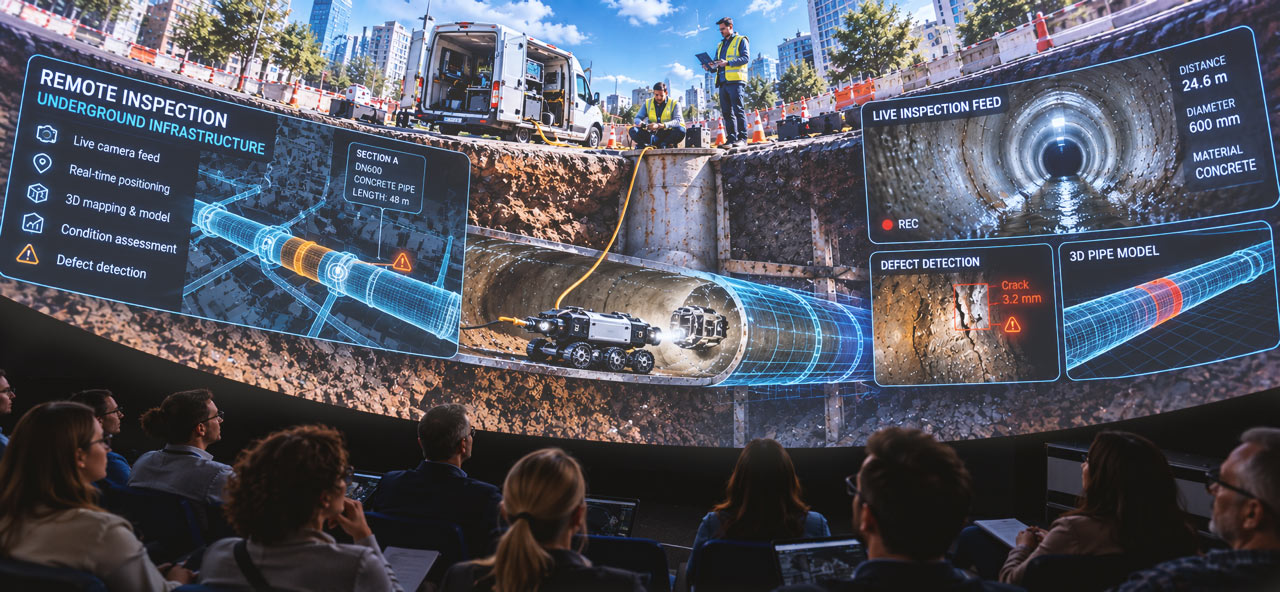
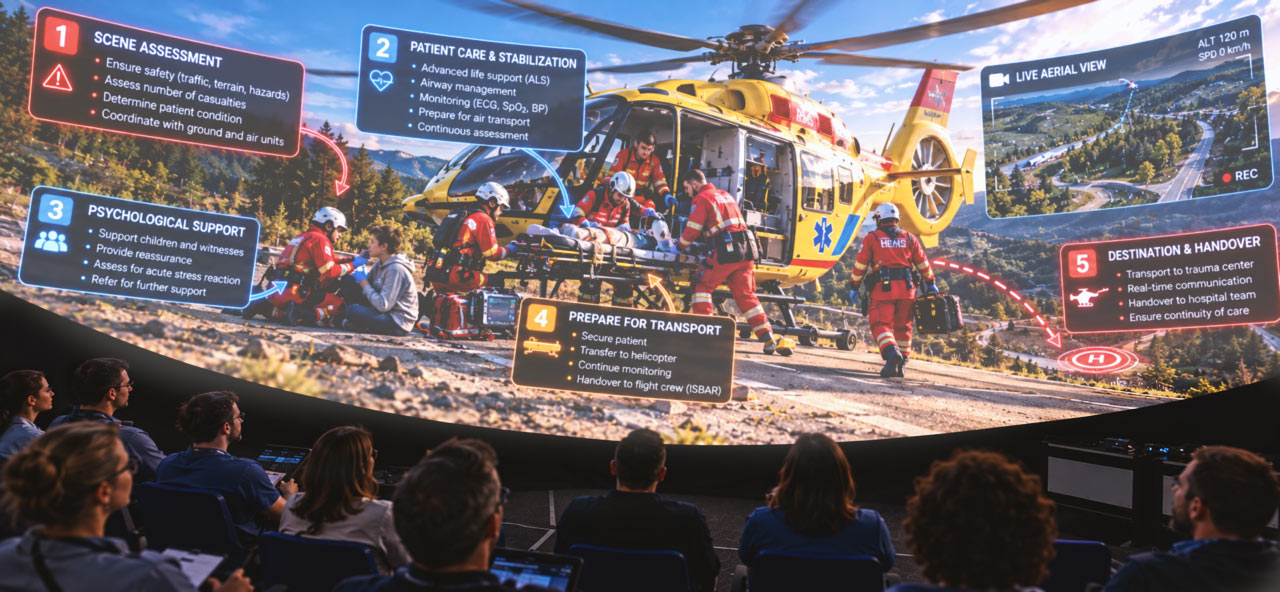
These are precisely the types of situations where the ability to safely experience and practise a dangerous or unusual scenario can have particular value.
Immersion alone is not enough
Research does not show that every VR training session is automatically better than a PowerPoint presentation.
One safety-training experiment found no clear advantage from VR alone when both training methods presented similar content. (sciencedirect.com)
This leads to an important conclusion:
Simply moving presentation slides into a 360° environment is not enough.
The greatest value emerges when participants:
- enter a realistic scenario,
- make decisions,
- respond to changing conditions,
- cooperate with others,
- practise procedures,
- receive feedback from an instructor.
From presentation to experience
In traditional training, participants usually:
listen → watch → remember.
In SimuDome training, they can:
observe → experience → decide → see the consequences → discuss them with an instructor.
This approach can be applied to scenarios involving:
- blackouts,
- evacuation,
- fires,
- floods,
- emergency alerts,
- civil protection,
- crisis management,
- industrial procedures,
- workplace safety,
- emergency response.
Why SimuDome?
SimuDome combines immersive training, 360° projection, interactive content and instructor-led learning.
Unlike conventional individual VR solutions, an entire group can share the same immersive environment.
The instructor can:
- pause the scenario,
- ask questions,
- trigger subsequent events,
- ask participants to choose a course of action,
- change how the situation develops,
- discuss incorrect decisions,
- conduct a debriefing after the exercise.
This enables interactive group training in which technology does not replace the instructor. Instead, it gives the instructor a powerful tool for creating realistic learning experiences.
What does the research tell us?
The key conclusion is simple:
The most valuable immersive training is not about watching content on a bigger screen. It is about active participation.
Research into VR, CAVE, fulldome and simulation-based learning indicates that appropriately designed immersive environments can support:
knowledge retention, recall, attention, procedural learning and the practical rehearsal of responses.
At SimuDome, we therefore develop innovative interactive training experiences in which participants do more than receive information.
They experience the situation, make decisions and practise their response.
This is where immersive training has its greatest potential: creating learning experiences that help participants not only understand what to do, but also remember how to respond when it matters.
Scientific sources
Yu, K. C., Sahami, K., Denn, G., Sahami, V., Sessions, L. C. (2016).
Immersive Planetarium Visualizations for Teaching Solar System Moon Concepts to Undergraduates. Journal of Astronomy & Earth Sciences Education, 3(2), 93-110. Study involving 781 students comparing an immersive fulldome environment with flat-screen instruction.
Source
Coban, M., Bolat, Y. I., Goksu, I. (2022).
The potential of immersive virtual reality to enhance learning: A meta-analysis. Educational Research Review, 36, 100452. Meta-analysis covering 48 studies and 3,179 participants.
Source
de Back, T. T., Tinga, A. M., Nguyen, P., Louwerse, M. M. (2020).
Benefits of immersive collaborative learning in CAVE-based virtual reality. International Journal of Educational Technology in Higher Education, 17, 51.
Source
Increasing the immersivity of 360° videos facilitates learning and memory: implications for theory and practice (2024).
Educational Technology Research and Development. Study comparing learning and memory in immersive and flat-screen environments.
Source
Immersive procedural training in virtual reality: A systematic literature review (2024).
Computers & Education. Review of immersive VR for procedural and skills training.
Source
Virtual reality for safety training: A systematic literature review and meta-analysis (2024).
Safety Science, 171, 106372. Analysis of 52 publications examining VR in safety training.
Source